Chapter 2. Medieval
2.1 Overview of the cycle
We bracket
the secular cycle of medieval
In our
discussion of each case study we use the following scheme. First, we present
the data on the dynamics of the major variables that lie at the heart of the
demographic-structural explanation of secular cycles. We start with demographic
and economic variables, then move on to social structure and elite dynamics,
and finally to political aspects. Once the general outlines of the cycle have
been established, we shift the focus to examining how these variables
interacted with each other during each of the phases of the cycle (expansion,
stagflation, crisis, and depression).
Trends in
population and economy
The major features
of population movements during this period are not in doubt (Hatcher 1977, Hallam 1988b,
Hatcher and Bailey 2001, Dyer 2002). There was a period of general
population growth up to the late thirteenth century, a peak in the vicinity of
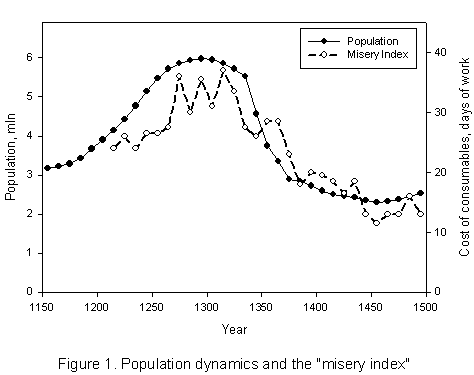
Figure 2.1. Population numbers and the “misery index” in
The starting
point of reconstructing the dynamics of English population is the Domesday Book
census of 1086. The census lists about 275,000 persons (Hatcher 1977:68) who were either males of working
age, or heads of households (Harvey 1988). This number needs to be converted
into total population. Additionally, allowance must be made for four northern
countries and two major cities omitted from the survey, and for the likelihood
of unrecorded sub-tenants and landless men (Hatcher 1977:68). One important source of
uncertainty is the multiplier that should be used to convert the heads of
households into the total population. Russell (1948), using a multiplier of 3.5 per
household, estimated the population of England in 1086 as 1.1 mln. By contrast,
Postan (1966) argued for a figure of 2.5 mln.
Currently, the multiplier estimate of 4.5–5 appears more plausible (Harvey 1988:48), and the most often quoted number
for population of England in 1086 lies in the range of 1.75–2.25 mln (Hatcher 1977:68).
The second
anchoring point is the 1377 Poll Tax, which indicates that there were between
2.5 and 3 mln people in England at that time (Hatcher 1977:68). Between 1348 and 1377 the
population probably dropped by 40–50%. Additionally, there was some decrease
from 1300 to 1348. On the basis of these considerations, Hatcher estimated the
peak population in 1300 as 4.5–6 mln, “with the balance of possibilities
pointing to the higher reaches of this range” (Hatcher 1977:68).
A similar
number was estimated by Hallam (1988b) working forward from 1086. Using
the information about the number of holdings recorded on various manors between
1086 and 1350, assuming that the household size was 4.7 people and the 1086
population 2 mln, Hallam (1988b:537) generated the following estimates:
Table 1. Population of England and Wales, estimated by Hallam
(1988b:537).
|
Year |
Population, mln |
Implied per capita growth rate, % per y |
|
1086 |
2.00 |
– |
|
1149 |
3.42 |
0.85 |
|
1230 |
4.96 |
0.46 |
|
1262 |
6.20 |
0.70 |
|
1292 |
6.52 |
0.17 |
|
1317 |
6.30 |
–0.14 |
These figures indicate that population and settlement
expanded in an uneven manner during the period of 1086–1300. Earlier (in 1956)
Michael Postan suggested that population expansion was most rapid to 1130,
while between 1130 and the closing quarter of the century population stagnated (Postan 1973:276). More recently, the same
conclusion was reached by Langdon and
Masschaele (2006:63).
In fact,
even this conclusion may be too optimistic. Certain data, although admittedly
fragmentary, suggest that population may have declined during the middle part of
the twelfth century as a result of the civil war between the adherents of
Stephen and Matilda. Thus, Gesta Stephani
speaks of villages “standing lonely and almost empty” and of unharvested fields
because the peasantry has perished or fled (Miller and Hatcher 1978:x). Furthermore, the amount of taxes
collected during the early years of Henry II reign shrank by 25% compared to
1130. This decline was not simply due to the disruption of revenue collection
resulting from the civil war. Officials reported that many previously
productive lands were now “waste”. Furthermore, the fiscal machinery of the
English state was fully recovered by 1165, yet it was only in the very end of
Henry II (1154-1189) reign when his revenues matched those enjoyed by Henry I.
Thus, it is very likely that general population declined during Stephen’s
reign. Rapid population expansion resumed at the end of the twelfth century and
continued during most of the thirteenth century. The sudden appearance of
inflation during 1180–1220 (Harvey 1973) is an indirect evidence of the
changed population regime.
Both Hatcher
and Hallam estimate peak population to be in the vicinity of 6 million people,
and that estimate is reflected in the curve in Figure 2.1. The case for lower
peak numbers—4.25 mln—continues to be made by Campbell (2005). Our inclination is to accept the
higher estimate, but whichever point of view prevails in the end is not
important for our main argument, because it relies on relative population changes, which are noncontroversial.
The final
signpost is the tax returns and muster cerificates of the 1520s, which suggest
that the population of England around 1522–25 was in the range of 2.25–2.75
mln (Hatcher 1977:69). There is a good reason to believe
that by this time population has recovered from the lowest point in the
mid-fifteenth century. Hatcher suggests that at the population nadir
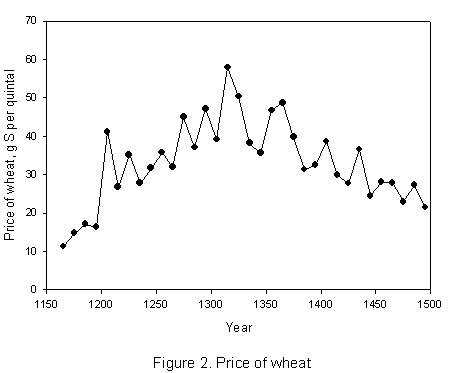
Figure 2.2 The price
of a quintal (
The movement
of prices mirrored faithfully population dynamics (Figure 2.2). Prices rose
from the low level of 1.5 s. per quarter of wheat (
Nominal
wages did not exhibit a cycle, but grew fairly monotonically. Thus, building
craftsman’s wage increased from
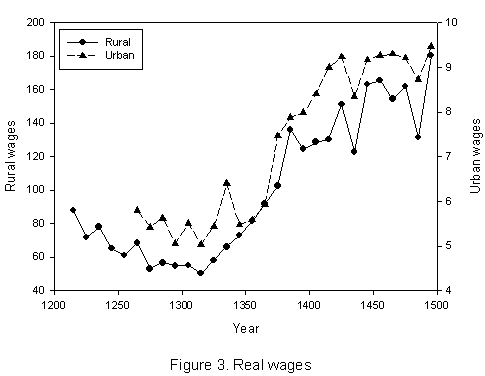
Figure 2.3 Real wages:
rural (Clark 2007b) and urban (Allen 2001). Arbitrary units.
Peasant
consumption patterns were also affected by population movements. During the second
half of the thirteenth century the peasant diet was dominated by bread, and
they ate very little meat (Table 2.2). The proportion of bread in diet started
to decline after 1300 and decreased to less than 20% after the Black Death.
Meat consumption increased from 4% in 1250s and 1260s to 30% in the end of the
fourteenth century.
Table 2.2 Foodstuffs
(by value, in percentages) consumed by harvest workers at Sedgeford, Norfolk (Dyer 2000:82).
|
Year |
Bread |
Meat |
|
Year |
Bread |
Meat |
|
1256 |
41 |
4 |
|
1353 |
31 |
15 |
|
1264 |
48 |
4 |
|
1368 |
19 |
25 |
|
1274 |
49 |
7 |
|
1378 |
15 |
24 |
|
1286 |
47 |
14 |
|
1387 |
14 |
30 |
|
1294 |
48 |
8 |
|
1407 |
17 |
28 |
|
1310 |
43 |
8 |
|
1413 |
20 |
-- |
|
1326 |
39 |
11 |
|
1424 |
15 |
28 |
|
1341 |
34 |
9 |
|
|
|
|
Social
structure and elite dynamics
Turning to
the social composition of the population, and how it changed during the cycle,
we first focus on the magnates (the upper elite stratum). In 1166 there were
133 baronies in England, defined as any tenure in chief with 5 or more knights’
fees (Painter 1943:26). In 1200 this number increased to
160 (Painter 1943:170). By 1300 the baronage may have
included well over 300 families. According to Matthew Paris, Henry III (d.
1272) could recall the names of 250 English baronies, and there were actually
even more “barons” because of partition among heiresses, since the holder of a
portion of a barony was still regarded as a baron (Pugh 1972:117). However, not all “barons” may be
considered as magnates. The question of whom to include into the top stratum of
the English society is further complicated by the shifting definitions, since
the decades around 1300 were a period of transition from the tenurial to the parliamentary
baronage (Painter 1943:173). The best guess is that there were
200–220 magnate families in England around 1300 (Painter 1943, Given-Wilson 1987). R. J. Wells (cited from Given-Wilson 1987:188) identified 217 families belonging
to the greater baronage in 1300. This number is not very different from 196
heads of noble families summoned to a parliament in the period of 1295–1325 (McFarlane 1973: Appendix B). To summarize, the numbers of
magnates increased between 1166 and 1300, but this increase probably did not
match the general population increase (Table 2.3).
Table 2.3 Numbers and incomes of English magnates (Painter 1943, Given-Wilson 1987).
|
Year |
Number of magnates |
Average income |
|
1086 |
170 barons |
£200 |
|
1166 |
133 barons |
£200 |
|
1200 |
160 barons |
£200 |
|
1300 |
220 greater barons (196 peers) |
£668 |
|
1436 |
73 peers |
£881 |
The dynamics
of the magnate stratum after 1300 can be followed using the data presented by
K. B. McFarlane (Table 2.4). Until 1350 the nobility increased or stayed
roughly constant (depending on whether we focus on the numbers at the start of
the period or total numbers). The size of the stratum started to decline after
1350, plunged during the first half of the fifteenth century, and then leveled
off by the end of the century. The number of peer families was still around
Table 2.4 Numbers of
noble families in
(McFarlane 1973: Appendix B).
|
Period |
Number of families at the start of the period |
New families summoned during the period |
Total families |
Extinctions during the period |
Extinction rate per 25 y, % |
|
1300–25 |
136 |
60 |
196 |
51 |
26.0 |
|
1325–50 |
145 |
47 |
192 |
45 |
23.4 |
|
1350–75 |
147 |
29 |
176 |
50 |
28.4 |
|
1375–1400 |
126 |
17 |
143 |
41 |
28.7 |
|
1400–25 |
102 |
11 |
113 |
40 |
35.4 |
|
1425–50 |
73 |
25 |
98 |
25 |
25.5 |
|
1450–75 |
73 |
22 |
95 |
24 |
25.2 |
|
1475–1500 |
71 |
10 |
81 |
20 |
24.7 |
|
1500– |
61 |
|
|
|
|
The
extinction rates calculated by McFarlane tell a similar story: a general
increase up to 1400–1425 and decline after that. However, an even more
important factor was a drastic drop in the number of new families summoned to
parliaments. Thus, the reduction in the peerage around 1400 was accomplished
both by enhanced extinction rates and by lowered upward mobility, while the
equilibrium of the post-1450 was a result of continuing low upward mobility and
decreased extinction rate.
We should
also comment on the fairly high average extinction rate, which fluctuated
between 25 and 35% per quarter-century. The average rate of 28% implies that
over 70% of families go extinct each century. Partly this result is due to the
technical definition of extinction used by McFarlane, which inflates somewhat
the real rate. But the conclusion is still inescapable: the English nobility of
the later Middle Ages were characterized a poor replacement rate. For
comparison, we can use the statistics compiled by R. J. Wells (cited from Given-Wilson 1987:188). According to Wells, of the 206
baronial families in 1216, 77 (37%) had gone extinct or suffered derogation by
1300. These numbers imply a 13% extinction rate per 25 years for the English
magnate families during the thirteenth century; a rate that is half that for
the succeeding two centuries. This difference is so strong that the qualitative
conclusion should remain unchanged even when we take into account the different
definitions of extinction used in these two studies.
To gain some
understanding of numerical dynamics of broader elite strata, we turn to the
remarkable data on Inquisitions Post Mortem analyzed by J. C. Russell (1948) and reanalyzed by T. H.
Hollingsworth (1969). The data deals with some 8,000
tenants in chief, that is, persons who held land directly of the king. The
sample includes both magnates and some individuals holding minute amounts of
land, but is dominated by middle-rank landowners, so it should give us a good
idea of what was happening to the elites as a whole. The replacement rate
(following recalculation of the Russell data by Hollingsworth) is plotted in
Figure 2.4. It shows that the numbers of elites continued to expand right up to
the Black Death (the replacement rate is above 1). During the next century the
pattern is of almost uniform decline, with the worst period around 1400. Only
after 1450 does the curve break above the replacement rate, while the “healthy”
increase rates of the thirteenth century are matched only at the very end of
the fifteenth.
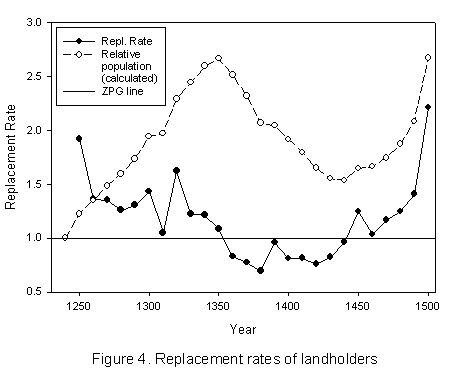
Figure 2.4 Numerical
dynamics of landed elites. Solid line: replacement rates calculated from
inquisitions post mortem. Dashed line: relative numerical dynamics calculated
from the replacement rates, assuming generation time of 32 y. “ZPG line”:
zero-population growth when the replacement rate is precisely one. Data source:
Hollingsworth (1969).
The pattern
of replacement rate curve shown in Figure 2.4 has interesting implications for
the dynamics of lord/peasant ratio during the fourteenth century. As noted
above, it is generally agreed that general population started declining soon
after 1300. The numbers of the landed elites, on the other hand, continued to
increase for another 50 years. We can estimate the magnitude of this increase
by calculating relative population of elites, starting with “
As a useful
indicator of elite consumption patterns we can look to the dynamics of
ecclesiastical building. Generally speaking, public building can be funded both
by the state and the elites, but in medieval
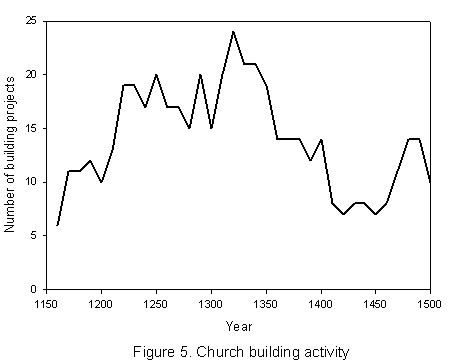
Figure 2.5 The number
of major building projects in progress in each decade from 1150 to 1500 (after Morris 1979: Figure 7).
State finances
The English
state in the Middle Ages derived its revenues from a bewildering variety of
sources, for which only fragmentary documentation has been preserved, making
the reconstruction of state budgets a very difficult task. Nevertheless,
various types of revenue can be grouped in three general classes: the crown
lands (“the farms”), taxation, and feudal sources. The relative importance of
these sources fluctuated during the period of interest. In 1086 the Crown held
around 18% of the landed revenues of the kingdom, valued at approximately
£11,000 per annum (Dyer 2002:82). The royal estates contributed 60%
of the total state revenue. In 1165 the farms were still responsible for 61% of
the total revenues, 23% were raised from taxation, and judicial and other
payments contributed 16% (White 2000:160). However, from that point on the
contribution of the crown lands exhibited a declining secular trend (although
there were several short-term fluctuations around this trend). Around 1300 the
farms yielded £13,000–14,000 (Dyer 2002:115), a major decline in real terms,
compared to the times of William I. At this time, the contribution of crown
lands to the total state revenues dropped to 20%. Another way of looking at
this number is to note that the king’s share of the overall landed income had
fallen to 2% (Dyer 2002:115). During the reign of Edward III
(1327–77) the farms contributed only 5% of the total income (Madge 1938:30).
Ramsay (1925) used Exchequer accounts (the pipe
rolls) to trace the history of royal revenues for the period of up to 1400. His
calculations have been much criticized for a variety of technical reasons.
However, we are interested not in specific numbers for any particular year, but
in overall dynamics of royal finances, and for that purpose Ramsay’s numbers can
serve as a rough guide. When expressed in real terms (deflating them by the
price of wheat), we observe that real revenues declined steadily during most of
the thirteenth century at the time when population increased (Figure 2.6).
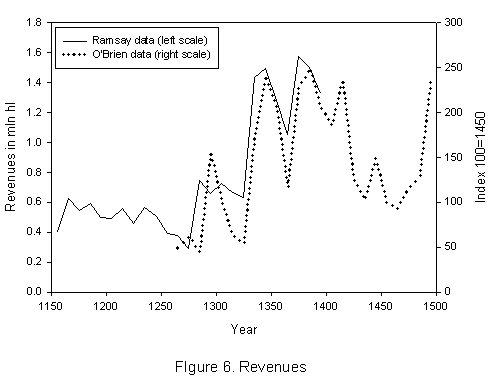
Figure 2.6 English
real revenues (1150–1400), based on the Ramsay (1925) data (solid line). The units are
millions of hectaliters. Revenue from taxation (1260–1500): decadal averages,
indexed to 1450 = 100% (based on O’Brien’s data from Richard Bonney’s
The
thirteenth century’s pattern of revenue decline was reversed in two spurts, the
first one under Edward I (1272–1307), and the second one under Edward III
(1327–1377). Since by the reign of Edward III, the farms have fallen to a very
minor part of royal revenues, the main new source of revenues was taxes, both
direct and indirect (Ormrod 1999). The rise (and fall) of medieval
English taxation is traced by the data compiled by Patrick O’Brien (Figure
2.6). These data indicate that after a peak achieved in the late fourteenth
century, tax revenues went into a decline that was reversed only after 1485
with the start of a new cycle.
Sociopolitical
instability
England
during the Middle Ages was racked by periodic baronial rebellions, which seemed
to recur at intervals of 50–60 years (Figure 2.7 and Table 2.5). However,
during the thirteenth century internal warfare was not as protracted and
intense as during the fourteenth and especially fifteenth centuries. This trend
can be measured, for example, by the treatment of defeated high-status enemies.
“Between the later eleventh and the early fourteenth century, defeated
political opponents of high birth were rarely dispossessed and scarcely ever
maimed or killed in cold blood” (Bartlett 2000:60). Internal wars during the
fourteenth and, particularly, fifteenth century were much more sanguinary. This
point is best illustrated by the fates of royal losers: the deposition was
followed by murder in prison (or, at least, death under suspicious
circumstances) for Edward II (1327), Richard II (1400), Henry VI (1471), and Edward
V (1483). Finally, Richard III was killed on the battlefield (1485).
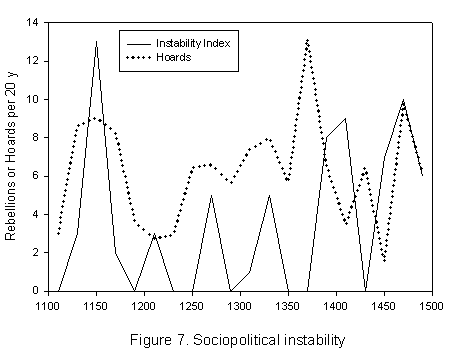
Figure 2.7
Sociopolitical instability in
Temporal
distribution of coin hoards supports this interpretation (Figure 2.7). After
the peak of the mid-twelfth century, hoards dropped off to the early thirteenth
century minimum. The thirteenth and fourteenth centuries saw a gradual (and
uneven) rise culminating in a peak c. 1370. Another great peak during the
second half of the fifteenth century closely tracks instability associated with
the Wars of the Roses. In fact, there is a general correspondence between the
peaks in the instability index, constructed by counting years in civil war or
rebellion per twenty years, and the temporal distribution of hoards (Figure 2.7).
The only significant mismatch is between the major peaks of
This
concludes our overview of general trends during the Plantagenet secular cycles.
In the next sections we turn to a more detailed discussion of
demographic-structural dynamics organized by cycle phases.
Table
2.5 Occurrence of rebellions, coups
d’état, civil war and other instances of internal war in
|
Period |
Description |
|
1138-53 |
Anarchy
(civil war between Stephen and Matilda/Henry) |
|
1173-4 |
Widespread
rebellion against Henry II |
|
1215-7 |
Civil war
between John and the barons (Magna Carta), then Royalists against rebels |
|
1263-7 |
Civil war
between “reformer” and “conservative” barons. Simon de Montfort defeats and
captures Henry. Defeat and death of de Montfort at Evesham |
|
1315 |
Civil
disorders (private wars in several southern counties) during supremacy of |
|
1321-2 |
Civil war.
Baron uprising in the western counties. Edward II defeated |
|
1326-7 |
Rebellion
of Isabella and Mortimer. Abdication of Edward II followed by his murder in
prison eight months later. |
|
1330 |
The coup
of Edward III against Mortimer (hanged, 1330) |
|
1381 |
Peasants'
Revolt |
|
1387-8 |
Insurrection
of the “Lords Appelant” |
|
1391 |
Coup
d’etat of Richard II |
|
1397-9 |
Events
leading to the deposition of Richard II (1399). Richard, furious at a
parliamentary demand for financial accounting, had the mover (Haxey) condemned
for treason (not executed). In the next Parliament three of the lords
appellant were convicted and executed for treason. The conspiracy of Henry of
Bolingbroke. Richard was forced to abdicate. He was thrown into the Tower and
later died (was murdered?) in prison (1400). |
|
1400-8 |
Glyn Dwr
rebellion |
|
1414 |
A Lollard
plot against the king's life |
|
1448-51 |
Domestic
disorders. Henry VI, declared of age (1437), was unfit to rule; the council
continued in power, and factions and favorites encouraged the rise of
disorder. The nobles maintained increasing numbers of private armed retainers
(livery and maintenance) with which they fought one another, terrorized their
neighbors, paralyzed the courts, and dominated the government. |
|
1450 |
Jack
Cade's rebellion |
|
1455-6 |
The Wars
of Roses: 1st phase. |
|
1460-5 |
The Wars
of Roses: 2nd phase. |
|
1467-71 |
The Wars
of Roses: 3rd phase. Edward's victory at Barnet (1471), where |
|
1483-5 |
The Wars
of Roses: 4th phase. Richard III aborted a rebellion conceived by Morton,
bishop of Ely, and led by the duke of Buckingham; the latter was beheaded.
The landing at |
|
1489 |
Rebellion
in Northumberland |
|
1495 |
Rebellion
of Perkin Warbeck |
|
1497 |
Insurrection
in |
2.2 The
expansion phase (1160–1260)
We lack
direct estimates, but lasting population growth must have started soon after
the end of Stephen’s anarchic reign and the establishment of stability under
Henry II. An indirect evidence of this growth is the persistent inflation in
the prices of wheat from 1160 (Figure 2.2). Other signs of overpopulation
include evidence of fragmentation of peasant holdings. In a classic paper on
the Somerset manor of Taunton, J. Z. Titow (1961) showed that in 1248 the
land/peasant ratio was
Political
instability during this period achieved the lowest level of the whole medieval
period (Table 2.5 and Figure 2.7). Nevertheless, this period was not
conflict-free. There were three major political crises: the rebellion of
1173–4, the civil wars at the end of John’s reign, and the troubles of 1258
leading into the “barons’ wars” of 1263–7 (Mortimer 1994:77). The troubles of 1173–4 started in
2.3 Stagflation
(1260–1315)
Rural
Population
Population
growth continued to 1300, but at a slowing rate, as overall population numbers
in
This period
saw the development of classical signs of overpopulation, as postulated by the
Malthusian/Ricardian framework. Prices reached the secular peak in the 1310s
(Figure 2.2), real wages declined (Figure 2.3), land rents increased (Table
2.6a). Entry fines paid on taking up tenancy was another method that landlords
could use to extract income from land. Evidence for fines prior to the
mid-thirteenth century is scarce, but what there is suggests that they
increased even more steeply than the rents (Table 2.6b).
Table 6. (a) Rents: 1000–1450
|
Period |
Rent,
d./acre |
Location |
Reference |
|
1000 |
0.3-0.6 |
|
(Dyer 2002:39) |
|
XI c |
1 |
|
(Miller and Hatcher 1978:45) |
|
XI c |
1 |
|
(Miller and Hatcher 1978:45) |
|
1251 |
2-4 |
Cambridgeshire |
(Bolton 1980:187) |
|
1251 |
4-6 |
|
(Miller and Hatcher 1978:45) |
|
1299 |
12.5* |
Bishopric of |
(Dyer 1980:72-3) |
|
1300 |
12 |
Cambridgeshire |
(Bolton 1980:187) |
|
early XIV c |
8-28 |
Huntingdonshire |
(Miller and Hatcher 1978:45) |
|
early XIV c |
33 |
|
(Miller and Hatcher 1978:45) |
|
early XIV c |
30-36 |
Northumberland |
(Miller and Hatcher 1978:45) |
|
1370-90 |
10.75** |
|
(Bolton 1980:214) |
|
1437 |
10.5 |
Warwickshire |
Fryde in Kaeuper 2000 |
*Average rents and dues per acre
**This is the open market rate; for customary land where
services were commuted landlords demanded 24 d., but could not find takers.
(b) Entry fines (1 virgate =
|
Period |
s./virgate |
Location |
Reference |
|
1214 |
1–1.67 |
Wiltshire |
(Miller and Hatcher 1978:46) |
|
1250 |
13.3–20 |
Ramsey estates, Hunts |
(Miller and Hatcher 1978:46) |
|
1296-7 |
30 (range 2–113) |
Earl of Cornwall estates, various counties |
(Miller and Hatcher 1978:46) |
|
1277-1348 |
8–47 |
Wiltshire |
(Miller and Hatcher 1978:46) |
|
1283-1348 |
39 |
Oxfordshire |
(Miller and Hatcher 1978:46) |
|
1283-1348 |
109 |
|
(Miller and Hatcher 1978:46) |
|
1300 |
60 |
general estimate |
(Dyer 2002:141) |
|
after 1300 |
>60 |
Ramsey estates, Hunts |
(Miller and Hatcher 1978:46) |
|
early XIV |
20–30 (max=100) |
Northamptonshire |
(Dyer 1980:47) |
|
early XIV c |
800–1600* |
|
(Miller and Hatcher 1978:46) |
*These are exceptionally high
An analysis of the Hundred Rolls of 1279–80 suggested that rent
per acre depended on the size of the holding, whether the tenant was free or
unfree, whether landlords were church or lay, and land fertility, among other
factors (Kanzaka 2002). Some of the variation in fines
was probably explained by differential land fertility, circumstances of the
prospective tenant, nearness to markets, and access to non-agrarian employment (Miller and Hatcher 1978:46). It is also possible that some
lords used entry fines as a way to increase returns on land where they had no
flexibility in raising rents, for example. The great amount of variability exhibited
by rents and fines precludes precise quantitative statements, but the overall
trend is unmistakable—the ability of landowners to extract surplus from
peasants increased during the stagflation phase.
Peasant
holdings became increasingly fragmented during this period. Here are some
numbers, brought together by Grigg (1980:68). On the Bishop of
Table 2.7 Distribution
of peasant land holding c. 1280 (Kosminsky 1956).
|
Land |
free |
villein |
all |
Percent |
|
Over virgate* |
521 |
173 |
694 |
3.2 |
|
One virgate |
904 |
3940 |
4844 |
22.6 |
|
Half virgate |
1083 |
5724 |
6807 |
31.8 |
|
Quarter virgate |
775 |
1378 |
2153 |
10.0 |
|
Small holders |
2251 |
4687 |
6938 |
32.4 |
*One virgate = 1 yardland =
Various
estimates of peasant budgets around 1300 have been made by economic historians (Titow 1961, Hilton 1966, see also
Hollingsworth 1969, Hallam 1988a, Dyer 1989). There is a general agreement
among these authorities that a typical peasant in 1300 holding half virgate of
land was barely making ends meet, if that. Let us retrace here the main points
of this calculation.
Table 2.8 Estimated Peasant Budget, assuming land holdings of
half-virgate =
q = 1 quarter of wheat (8 bushels =
|
Assumptions |
Calculations |
|
Production |
|
|
Crop acreage, assuming 3-field system |
|
|
Sowing rate per acre |
0.25 q |
|
Total seed |
0.25 q/acre × |
|
Yield ratio |
1:4 |
|
Crop harvested |
10 q |
|
Net (seed deducted) |
10 – 2.5 = 7.5 q |
|
Production in money (1 q = 6 s.) |
7.5 q × 6 s./q = 45 s. |
|
Extraction |
|
|
Tithe (10% of harvest) |
0.1 × 10 q = 1 q
= 6 s. |
|
Rent (1 s. per acre) |
1 s./acre × |
|
Other feudal exactions |
1 s. |
|
Taxes |
1 s. |
|
Death duties |
|
|
Heriot (best animal) |
1 bull = 10 s. |
|
Mortuary (another animal) |
1 bull = 10 s. |
|
Entry fee |
40 s. |
|
Total death duties |
60 s. |
|
same per year |
60 s./20 y = 3 s. |
|
Total extraction = (6+15+1+1+3) s. |
26 s. = 4.3 q |
|
Summary of peasant budget |
|
|
Total extraction |
4.3 q |
|
Remaining to the peasant |
7.5 q – 4.3 q = 3.2 q |
|
Minimum consumption |
4 q |
|
Deficit |
3.2 q – 4 q = – 0.8 q |
|
Deficit in money (1 q = 6 s.) |
0.8 q × 6s. = 5 s. |
|
Proportions |
|
|
Total production (assuming the deficit of 5 s. was somehow made up) |
45 s. + 5 s. = 50 s. = 100% |
|
Consumption (% of total production) |
24 s. = 48% |
|
Church tithes (% of total production) |
6 s. = 12% |
|
Landowner (% of total production) |
19 s. = 38% |
|
State (% of total production) |
1 s. = 2% |
The above calculation makes a number of simplifying
assumptions. For example, peasants did not grow just wheat, as assumed above. However,
the overall result is very similar when a more realistic mix of crops is
substituted. For example, Dyer (1989:113) performed a more elaborate
calculation, assuming that crops were split between wheat, barley, peas, and
oats. Repeating his calculation with the assumption that only wheat was grown,
we obtained a result that was less than 10% different from Dyer’s. Another
source of agricultural income that Table 2.8 does not take into account is a
cash income from animals. Dyer calculated that a peasant holding a virgate
would derive additional income of 33 s. from this source. Unfortunately, he did
not duplicate these detailed calculations for a half-virgater, but it is
unlikely these peasants with more typical land holdings would derive much
income from this source. They kept considerably fewer animals that full
virgaters, and what they kept would yield very little cash surplus after the
tithes and personal consumption have been taken into account. Perhaps it would
be enough to cover the calculated deficit of 5 s., or perhaps the peasant had
to rely on the garden or poultry, and the extra earnings by wife (spinning) or
family (sons hiring as agricultural labourers) would become very important in
meeting his obligations to the lord, church, and the state. “How he paid for
clothing, cooking pots, or furnishings is not at all clear”, concludes Dyer.
The final note here is that the calculations above assume normal conditions.
During the times of even mild crop failure, the half-virgater would have to go
in debt to survive.
These
calculations can also give us at least an order of magnitude of the estimated
proportion of resources extracted by the elites and the state from the
procuders. Assuming that peasants somehow could made up the deficit of 5 s.
through exploiting non-arable resources, their estimated total production rate
would be 50 s. per year. Of this amount, the church took 12% (this is an
underestimate that does not include the tithe on animals and garden produce),
the lord took 38% (again, an underestimate, because it does not include labor
services; also, various feudal exactions are probably underestimated at 1 s.
p.a.), and the state took a tiny 2%, leaving the peasant less than half of the
product (and barely enough for basic subsistence).
While
typical half-virgaters were balanced on the edge of survival, those few
well-to-do peasants who had a virgate did much better. On the basis of his
investigation of the manor of Bishop’s Cleeve in Gloucerstership in 1299, Dyer (Dyer 1989:117) concluded that “an average
yardlander in a normal year was in a good position to make a cash surplus”. By
contrast, a smallholder in order to make ends meet had to find employment for
130 days per year. Since the numbers of such smallholders were very large, it
is likely that only a small minority of them would be able to secure full
employment. The contrast between the economic position of different peasant
strata can be further illustrated by the fact that around 1300 at Halesowen in
Worcestershire the wealthier peasants had on average 5.1 children, compared to
the cottagers’ 1.8 offspring (Dyer 2002:158).
One
remarkable feature highlighted by the above calculation of the peasant budget
is how little – 2% – of peasant-generated product went to the state. Our
estimate of taxes equaling 1 s. p.a. follows Dyer (2002:258), who calculated that a peasant
born in 1270 and acquiring a holding of
The state,
of course, had other sources of revenues than lay subsidies that affected
pesants directly. However, Dyer (2002:257) estimated that in 1297 the crown’s
taxes amounted to only 2% of the estimated Gross Domestic Product. In sum,
The chief
factor underlying popular immiseration in the late thirteenth century, however,
was not surplus extraction by the feudal lords, but the massive population
growth during the preceeding century. Furthermore, the effect of population
growth was not just that it decreased peasant/land ratios on average, but that
it also resulted in growing inequality of land holdings. One third of rural
freeholders held an acre or less of land, while another third held between 1
and
Urbanization
Keene (2001:196) speculated that in 1100 there were
20,000 Londoners, or 0.8% of the total population in the country. By 1300
population of London reached 80,000, constituting 1.3% of the total (Keene 2001:195). The poll taxes for 1377 indicate
that 1.7% of the assessed population of England was found in London (Keene 2001:194), suggesting that there were
slightly under 50,000 Londoners. In summary, between 1100 and 1400 the
urbanization index of
The proportion
of population living in large towns (over 10,000 people) also increased. In the
eleventh century there was only one such town, London, while by the end of the
thirteenth century there were between 14 and 16 towns with population 10,000 or
more, which contained at least 5% of the population of England (Britnell 1995:10). Urbanization continued to
increase during the fourteenth century.
In addition
to the expansion of urban populations in established towns, new towns were
founded during the twelfth and thirteenth centuries. For example, planned towns
built in England and Wales reached a peak during the second half of the
thirteenth century (Beresford 1967:366).
The increase
in the proportion of population found in towns during the fourteenth century
was clearly not a result of better demographic rates there, compared to rural
locations. In fact, everything we know about medieval cities suggests that they
were population sinks (“death traps”). Most English towns were decimated by the
outbreaks of the plague (Dobson 2001:276), but then made up losses as a
result of immigration from rural areas. Direct evidence of this process comes
from the spectacular increase in the recruitment of new citizens recorded in
York’s freemen’s register (Dobson 2001:276). Populations of some cities, like
Coventry, actually expanded during the second half of the fourteenth century in
spite of the ravages of the Black Death (Phythian-Adams 1979:33).
The Elites
While
general population growth slowed sometime during the thirteenth century, and
eventually reached the peak around 1300, the elite numbers continued to expand
throughout the stagflation phase, and even beyond it (to 1350). In general, the
elites did well economically during the thirteenth century. At the top, the
number of magnate families expanded only slightly – from perhaps 160 to 200
families, but their average income grew from £200 to £670 p.a.,
which represents more than a two-fold increase in real terms (Table 2.9a).
Table 2.9 Changes in
the social structure of the top strata, 1150–1450.
(a)
Magnates (data from
Table 3)
|
year |
Numbers |
Avg. income |
Real income, hectaliters |
|
133 |
£200 |
7,700 |
|
|
1200 |
160 |
£200 |
3,100 |
|
1300 |
200 |
£670 |
6,600 |
|
1436 |
70 |
£880 |
8,600 |
(b) Middle
ranks
|
year |
Designation |
Numbers |
Min income |
Real min income* |
Reference |
|
1100 |
“belted knights” |
1,000 |
£5 |
190 |
(Dyer 2002:85) |
|
1200 |
belted knights |
1,000** |
£10 |
160 |
(Painter 1943:172) |
|
1300 |
knights and esquires |
3,000*** |
£20 |
200 |
(Given-Wilson 1987:18) |
|
1400 |
knights and esquires |
2,400 |
£20 |
180 |
(Given-Wilson 1987:73) |
|
1500 |
knights and esquires |
1,300 |
£20 |
190 |
(Mingay 1976:4) |
*in hectaliters of grain
**A guess
assuming that the numbers of belted knights did not change much during the
twelfth century
*** Of which
1,250 knights
(c) Lesser elites (very approximate)
|
Period |
Designation |
Numbers |
Min inc. |
Real min inc.* |
Reference |
|
c.1100 |
lesser
landholders |
7,000–8,000 |
£1 |
40 |
(Dyer 2002:85) |
|
c.1200 |
knights |
4,500–5,000 |
? |
|
(Bartlett 2000:216) |
|
c.1300 |
country
gentry |
18,000–20,000 |
£5 |
50 |
(Denholm-Young 1969:16) |
|
c.1300 |
gentry
& clergy** |
20,000 |
£10 |
100 |
(Dyer 2002:152) |
|
XIV cent. |
gentry |
9,000–10,000 |
£5 |
45 |
(Given-Wilson 1987:72) |
|
XV cent. |
gentry
& clergy |
10,000 |
£10 |
100 |
(Dyer 1989:32) |
|
XV cent. |
gentry |
6,000–9,000 |
£5 |
50 |
(Pugh 1972:97) |
|
1436 |
taxpayers
with incomes <£40 |
6,200 |
£5 |
40 |
(Gray 1934:630) |
|
c.1500 |
gentry |
5,000 |
£5 |
55 |
(Mingay 1976:4) |
* In
hectoliters of grain
**Households
enjoying £10–100 p.a., includes beneficed gentry
The middle
ranks also participated in this expansion: whereas there were perhaps 1,000
belted knights (substantial land-owners holding land worth at least £10
p.a.) in 1200, by 1300 there were 3,000 knights and esquires with incomes over
£20 p.a., a rough equivalent in real terms of £10 in 1200 (Table
2.9b).
The numbers
of lesser landholders also grew, although a precise numerical estimate of this
increase cannot be given: Given-Wilson estimated the numbers of lords with
income over £5 at 9,000–10,000 in the fourteenth century, while
Denholm-Young proposed a number twice that (Table 9c). Dyer suggests that there
were 20,000 households who enjoyed incomes between £10 and 100 p.a. in
1300. This estimate, however, includes beneficed clergy, while excluding those
lesser landowners whose incomes were between £5 and 10.
The truth
probably lies between these extremes: in general, it seems likely that the
numbers of landholders kept pace with that of the general populace (although with
a lag, see below), in which case they should have tripled from around
The size of
the non-productive class was greatly bloated by the huge numbers of the clergy.
England of the thirteenth century was “swarming with clerics” (Jessopp 1892). There were an estimated 25,000
monks and nuns (Moorman 1946:258). As to the numbers of parish
clergy, estimates range from 40,000 (Moorman 1946:53) to 2% of population (Coulton 1907), which would imply a staggering
figure of over 100,000. There were 9,000–10,000 parishes in thirteenth century
England (Moorman 1946:5) and around five ordained men per
parish (Moorman 1946:55). For example, Hilton (1966:62) estimated that there were 2,000
ordained clerics in the diocese of Worcester, which had 445 parishes. These
numbers, thus, imply an estimate of 50,000 secular clergy in
The
foundations of elite prosperity were provided by the plentiful labor supply,
leading to increasing rents and declining wages. As a result, the elite incomes
from land kept pace, or even grew faster than inflation. Dyer (2002) suggests that “the main benefit
for lords came from additions to the numbers of customary tenants who owed
heavy burdens of labor service and cash payments”.
The gap
between the economic well-being of commoners and elites increased: while the
incomes of peasants plummeted as a result of lack of land, increased rents, and
decreased wages, the elite incomes increased both in absolute and relative
terms. This trend can also be seen in the dynamics of military wages. The rate
of pay for elite soldiers (knights) grew faster than inflation, while real
wages of commoners (foot soldiers) declined (Table 2.10).
Table 2.10 Daily rates
if pay for soldiers in
|
Period |
Knight |
Foot soldier |
Knight/foot ratio |
|
1060 |
4d. |
|
|
|
1160 |
6d. |
|
|
|
1165 |
8d. |
1d. |
8:1 |
|
1195 |
1s. |
|
|
|
1215 |
2s. |
2d. |
12:1 |
|
1250 |
2s. |
|
|
|
1300* |
2, 3, or 4s. |
2d. |
18:1 |
*Rates varied according to rank: between 2s. for a
knight-bachelor and 4s. for a knight-banneret.
The overall pattern
in incomes up to 1300, therefore, was one of increasing inequality: the
standard of living of commoners declined, gentry incomes generally outpaced
inflation, while the magnates did best of all. In Henry II’s reign few lords
had an income exceeding £500 p.a. (Bartlett 2000:80). The highest income in Sidney
Painter’s list of 54 barons around 1200 was the £800 enjoyed by Roger de
Lacy, constable of
Another way
to address the well-being of elites is to examine their consumption of
luxuries. Wine consumption reached the medieval peak in the early fourteenth
century, when the English imported 20,000 tuns from Gascony (Dyer 1989) worth wholesale £60,000 (Miller and Hatcher 1978:81). Assuming there were 20,000 elite
households at that time, this represents 2–3 liters of wine per household per
day!
2.4 Crisis (1315–1400)
Population
decline
The economic
misery of commoner population steadily grew during the stagflation phase and
reached the peak in the early fourteenth century. Peasants were squeezed from
below by an insufficient land supply, resulting from too many people competing
for limited land, and from above by an expanding (and increasingly rapacious)
class of noble landowners eager to maintain the consumption levels to which
they had become accustomed during the thirteenth century. There were important
regional variations in how the social structure responded to population
pressure. In East Anglia, for example, the freeholder stratum (the sokemen)
progressively subdivided their land among heirs resulting in proliferation of
smallholders with tiny plots of land (Poos 2004). In the South, by contrast,
manorial lords exerted a better control over land distribution, so that a
substantial minority of peasants held from one-quarter to a whole virgate
(between 3 and
The classic
study of Postan and Titow (Postan 1973: Chapter 9) on the heriots paid on five
Winchester manors allows us a glimpse into how mortality rate fluctuated
between 1245 and 1350 (heriots were paid when a tenant died and another
replaced him). The average number of heriots more than doubled from 47 per year
during the second half of the thirteenth century to 106 during the decade of
1310–19. But most revealing are the dynamics of one category, money heriots,
paid by the poorer villages who had few or no beasts, and by implication few or
no acres of land (Miller and Hatcher 1978:58). The number of money heriots
fluctated around 10 per year until 1290, and then experienced rapid growth to
the peak of almost
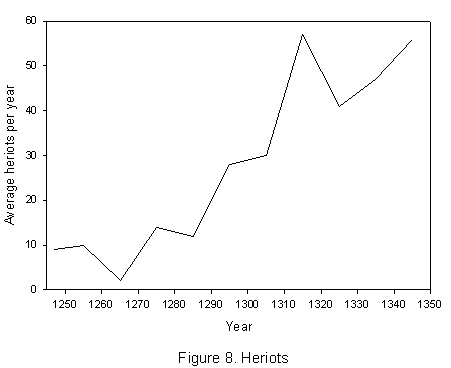
Figure 2.8 Number of
money heriots paid on Winchester manor, 1245–1348 (data from Postan 1973:Table 9.2).
The period of
severe harvest failures and livestock epidemics between 1315 and 1322 was a
dividing line in the history of the medieval English countryside (Miller and Hatcher 1978:60). A poor harvest of 1314 was
succeeded by two disastrous harvests of 1315 ansd 1316. Harvests improved after
1317, but a series of deadly epidemics affected cattle herds between 1319 and
1321. The agrarian crisis of 1315–1321 resulted in a noticeable decline of
population. Direct evidence of this fall is fragmentary, but we know that the
tithingpenny data from Essex parishes indicates that between 1300 and 1340 the
number of tithingmen declined by 30 percent (Poos 1985). Indirect evidence of the
population decline was a significant increase in the number of unwanted
holdings signaling the slackening of competition for land (Miller and Hatcher 1978:59). Wheat prices during the 1330s and
1340s declined to the levels not seen since 1270 (Figure 2.2), and the secular
trend was definitely down, although with significant fluctations. By the 1340s
the amount of uncultivated land reached noticeable dimension in some counties
such as Sussex or Cambridgeshire (Miller and Hatcher 1978:61).
The
disasters of 1315–1321, however, soon paled into insiginficance compared to
what was yet to come. In 1348 the Black Death arrived in
The effect
of the Black Death on social structure
As we noted
above, demographic rates varied widely among various social strata. Wealthier
peasants had 2–3 times as many children as cottagers, and their death rates
tended not to be affected by crop failures. Moving up the social scale, we also
saw that while the general population in
Table 2.11. Mortality
rates (%) of various social strata in
|
Stratum |
1349 |
1361 |
1369 |
1375 |
References |
|
Monks |
45 |
|
|
|
(Hatcher 1977:22-25) |
|
Beneficed clergy |
40 |
14 |
13 |
|
(Hatcher 1977:22-25) |
|
Tenants-in-chief |
27 |
23 |
13 |
12 |
(Russell 1948:216-8) |
|
Bishops |
18 |
|
|
|
(Hatcher 1977:22-25) |
|
Peers |
8 |
19 |
6 |
5 |
(McFarlane 1973:170) |
The highest
mortality rates during the first and most severe outbreak of 1348–9 were
observed among monks and beneficed clergy. Parish priests are of particular
interest, because although they were better fed and housed, which would tend to
lower death rates, conscientious performance of their duties would tend to rise
them (Hatcher 1977:23). Thus, their death rates provide a
reasonable estimate of the death rates among the general rural population. In
fact abundant, although varying in quality, data from manorial records,
reviewed by Hatcher (1977:22) suggests that the death rate of
beneficed clergy is an underestimate of that of peasants.
If peasant
death rates were over 40%, middle-rank elites suffered only 27% mortality,
while the magnates escaped with even lighter losses of 8–18% (Table 11). The
privileged groups had a better than average chance of escaping infection
because they lived in stone houses (rats preferred wood houses) and they could
flee the advancing plague (Hatcher 1977:23). However, the elites apparently
paid the price during the next epidemic of 1361–2. Among the general population
the death rates were much lower than during the first visitation of the plague
in 1348–9. A numerical estimate is again provided by the death rates of the
beneficed gentry (at least for the adult population, see Table 2.11). The most
likely reason is the build-up of resistance to infection among the population
(which was a direct consequence of removal of those who were most susceptible
in 1348–9, leaving those who were more resistant). While the first epidemic
struck mainly at people in the prime of life (Hatcher 1977:24), later epidemics had a
disproportionate effect on the children. There was also a disproportionate
effect on the higher ranks: the mortality rate of tenants-in-chief was hardly
lower in 1361 than in 1349, while the death rates among the peers actually
increased (Table 11).
To summarize
the numerical dynamics of the productive and elite strata during the phase of
crisis, the numbers of peasants started declining no later than in 1315 and
took a plunge in 1348–9, while the numbers of elite expanded until 1348 and
declined at a much milder rate between 1348 and
An even
worse threat for the elite incomes was an indirect consequence of the post-1348
depopulation. Since the thirteenth century the landlords had become accustomed
to the high supply of labor driving high rents/entry fines and low wages. This
economic clout was lost after 1348, and ultimately resulted in a substantial
reduction of per capita incomes enjoyed by the elites. Particularly badly hurt
were the middle ranks and lesser landowners who relied on personal servants and
hired labor to farm substantial properties (Fryde 1991:755).
How did the
elites deal with this threat? Apparently, they immediately recognized the
enhanced bargaining power of peasants, and took steps to legislatively fix the
rents and wages at rates prevailing before 1348. The Ordinance of Laborers was
vigorously enforced, although ultimately economically ineffective. It foundered
on the “freerider problem”: it was to the benefit of each individual employer
that others would be limited to lower wages, so that he could attract
sufficient labor by offering a slightly better wage. Since everybody felt the
same way, the limits on wages quickly unraveled. Characteristically, the
employers (the gentry) were not prosecuted for offering illegal wages, while
many laborers were punished for accepting them. The labor legislation, in
general, was the focus of much popular hatred, and its enforcement was one of
the important causes of the peasant revolts of 1381 (Fryde 1991:760). Another element of the
“seigneurial reaction” was implemented by landlords in their private courts.
Manorial courts increased their revenues after the Black Death, a remarkable
achievement as the numbers of tenants had fallen drastically (Dyer 2002:286).
The magnates
did better than the middle-rank and lesser elites, at least to 1380. The large
landowners employed numerous retainers whom they could, and did employ to
intimidate peasants to continue to accept high rents and low wages that
prevailed before
In general,
the elites enjoyed a temporary success in postponing the effects of the
depopulation brought about by the Black Death for about a generation. Wages
rose gradually and reached their highest level only 20–30 years after the first
epidemic (Dyer 2002:293). Incomes of lords declined, but
not drastically. The aristocracy continued to enjoy a high level of expenditure
that they had become accustomed during the century around 1300. Another factor
contributing to the well-being of elites was the initial success of the English
in the Hundred Years War (this will be discussed below). This is probably the
explanation why the trade, industry, and towns continued to do well after 1348 (Dyer 2002:296).
In fact, the
degree of urbanization of
Elites in
Crisis
As it became
clear that no more revenue could be squeezed out of the peasants, the elites
increasingly sought other means of additional income. One avenue of
advancement, open to impoverished but ambitious individuals, was to join the
retinue of a great lord, or find employment with the Royal government.
Increased competition for such elite positions was manifested in the spread of
literacy among the aristocracy. As Denholm-Young (1969:2) notes, during the fourteenth
century the miles literatus ceased to
be a rarity. (In the fifteenth century, when intraelite competition slackened,
there was a decline in the student population of, for example Oxford (Thomson 1983:351).) However, by far the most common
employment was in the military.
The extent
of aristocratic involvement in the war during the fourteenth century was
remarkable, especially during the period 1338–61, when the English enjoyed a
string of successes in
Knights were
paid at the rate of 2–4 s. per day, depending on the rank. Thus, two or three
months of campaigning would add up to a substantial sum (£6–18), given
that about £20 p.a. was needed to support a knight during the fourteenth
century. Many archers were probably recruited from the ranks of impoverished
lesser gentry (Powicke 1962). Although their rate of pay (2 d.
per day) was relatively low, they could improve their fortunes by a windfall of
booty or a ransom. In addition to wages, the spoils of war included plunder,
ransoms paid by captured French noblemen, and indemnities paid by occupied
fortresses and towns (rachâts).
The order of magnitude of these cash flows is indicated by the crown’s portion:
Edward III received more than £250,000 in ransoms for Kings John of
France and David of Scotland, and a similar amount from rachâts (Postan 1973:74-5). Finally, the conquests brought
with them landed income. For example, when Normandy, Maine, and Anjou were
conquered during a later stage of the Hundred Years War, Henry V conferred
lands worth about £30,000 on his followers (Bean 1991:566).
English
medievalists have debated whether the Hundred Years War paid for itself, or
resulted in a net loss (Postan 1973:63-80). Whatever the general answer, it
is clear that for the elites it was a very lucrative enterprise, because the
rewards went primarily to them, while most of the costs of the war (the bulk of
taxation, purveyances, etc) were born by the commoners. Thus, according to the
estimate by McFarlane, out of over eight million pounds in taxes levied for war
purposes over the 120 years, half came from taxation on wool.
There is no
question that the elites did very well out of the war, as long as it went well
for the English. When Edward III returned to England in 1346, after the
victorious battles of Crécy and Neville’s Cross (where the Scots were
defeated and King David II captured) the rolls of parliament record that “all
thanked God for the victory he had granted to their liege lord … and said that
all the money they had given him had been well spent” (King 1979:157-8).
Eventually,
however, the respite brought about by military successes in
Squeezed by diminishing
returns on the land and deprived of opportunities of overseas profits from
conquest, the elites put more pressure on the state finances, resulting in a
greater proportion of the crown’s income that was diverted in their direction.
If the annuity bill of Edward III in the 1360s was £13,000, by 1399
Richard II’s was closer to £25,000 (representing a three-fold increase in
real terms). However, only a small proportion of the aristocracy could benefit
from these funds, small relative to their numbers and appetites. A similar
pressure from lesser gentry, coupled with the magnates’ need for large retinues
to defend their interests in parliaments, courts, and factional conflict, lead
to the development of what became known as “bastard feudalism”. Mertes (1988: Appendix C) presents evidence that the average
retinue of magnates (peers and bishops) increased from 50 during the first half
of the fourteenth century to over 150 during the second half of the fifteenth.
The rise of
huge baronial retinues was one of the outward manifestations of intense
intraelite competition, increasing factionalization of
The Rise
and Fall of State Finances
As we noted
above, the demands made by the English state on the society during the
thirteenth century were mild. Taxes stayed approximately constant or even
declined in real terms before 1290, implying that the proportion of GDP going
to the state took a plunge (since both GDP and population expanded greatly
during the same period). Even during the local peak around 1300, after taxes
were doubled, they were less than 2% of GDP.
Revenues of
the crown doubled during the early stages of the Hundred Years War (Figure 6).
During the 1370s and 1380s, the revenues stayed roughly at the same level, but
since population has been reduced by half, this represents another doubling of
the tax burden. Additionally, the aim of the new poll taxes, first granted by
the parliament in 1377, was to shift the burden of taxation towards the
peasantry (King 1979:163).
Between 1369
and 1380 the English government incurred extraordinary expenditures amounting
to more than £1.1 mln (Fryde 1991:43). After some political struggle
(the “Good Parliament” of 1376 rejected the crown’s requests for direct
taxation, while the parliament of 1377 granted a direct subsidy in the novel
form of a poll tax) the decision was reached to bring into the tax system a
large segment of lower classes of the population that were previously exempt (Dyer 2002:284). Unprecedented taxes were imposed
on the population in 1377, 1379, and
According to
the calculations of W. M. Ormrod and Patrick O’Brien the maximum yield from
taxes (in real terms) was achieved during the decade centered on 1340
(1336–45). The general trend for the next century was down. This secular trend,
however, was overlaid by shorter-term fluctations, whose peaks (in 1300, 1340,
1380, and 1420) closely correlated with periods of intensified warfare against
Rising
Sociopolitical Instability
Popular
immiseration, intraelite conflict, and the state’s financial difficulties were
the primary factors underlying the unraveling of social order, which was
experienced by the English society during the forteenth century. However, the
rise of sociopolitical instability between early thirteenth and late fourteenth
centuries (Figure 2.7) was not a simple, unilineal dynamic. The rising secular
trend was overlaid by a series of waves, which tended to occur every other
generation. The most significant period of unrest during the thirteenth century
was the crisis of 1258 leading into the “barons’ wars” of 1263–7 (Mortimer 1994:77).
The next
wave of internal war occurred in the 1320s during the last half of Edward II’s
reign. It began with the unsuccessful rebellion of the barons of the Welsh
The reign of
Edward III was relatively free of internal strife (except at its very end),
because the focus of elite energy was directed towards the war against
The Late
Medieval Crime Wave
The
fourteenth and fifteenth centuries were also periods of heightened criminal
activity—the so-called “Late Medieval Crime Wave” (Dean 2001). Based on her analyses of the
coroner’s rolls, Barbara Hanawalt (1976, 1979) showed that the best explanations
for changes in the pattern of crime in fourteenth-century England were economic
changes and war. Economic crimes increased during the periods of scarcity.
Thus, the number of burglaries increased enormously during the period of
1315–19 (Figure 2.9) as a result of the Great Famine. Annual statistics of
economic crimes followed very closely fluctations in the price of wheat (see Figure 12 in Hanawalt 1979).
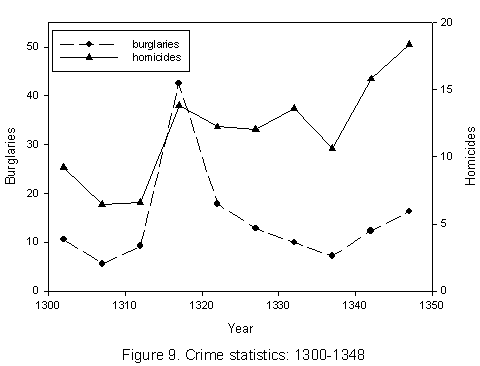
Figure 2.9. Number of
crimes (burglaries and homicides) committed in eight counties of England during
1300–48 (averages over the counties and five-year periods) (Hanawalt 1979: Tables 9 and 10).
Homicides
tended to be primarily affected by political strife and war. This conclusion is
supported by the more detailed analysis of criminal patterns focusing on each
county (Hanawalt 1979:229-238). For example, Herefordshire was
the scene of some of the major phases of the civil war which led to the
deposition of Edward II, and the highest peak in crime in this county was
achieved not during the famine of 1315–17, but during civil war. The periods of
Scottish wars (1314–19, 1322–23, and 1332–37) all coincided with rises in
crimes in
Table 2.12. The average number of homicides per year in rural
Northamptonshire (Hanawalt 1976: 303).
|
Period |
Homicides |
|
1300-29 |
11 |
|
1330-39 |
13 |
|
1340-49 |
21 |
|
1350-59 |
10 |
|
1360-69 |
18 |
|
1370-79 |
14 |
Intraelite
conflict took various forms, ranging from full-scale civil war to persistent
infighting between noble factions down to small-scale feuding and
individual-on-individual violence. In the fourteenth century’s Gloucestershire,
more than half of resident knights and esquires committed at least one felony
or trespass (Saul 1981:174).
2.5 Depression (1400–85)
As we stressed in the introductory chapter, all temporal
break points are to greater or lesser degree arbitrary, and this applies with
particular force to the year of 1400. There was no abrupt transition in that
year, and in fact, outbreaks of civil war continued to arrive in a recurrent
fashion.
General
population and peasant economy
During the
fifteenth century the population numbers in
However, it
is likely that regional variation and population redistribution were more
important than whatever national trend obtained. People moved from rural areas
to towns and from one village to another. Between 1370 and 1520 at least 2,000
villages were deserted in England (Dyer 2000:350).
Low
population densities translated into greatly improved living standards. Real
wages continued to increase during the first half of the fifteenth century,
although at a slowing rate (Figure 2.3). Peasants ate less bread and more meat,
fish, and dairy products. For example, bread accounted for about half of the
value of foodstuffs consumed by harvest workers in
As we
remarked in Chapter 1, the great puzzle of late-medieval English demographic
history is why excellent real wages, consumption patterns, land/peasant ratios,
and low rents did not translate into renewed population growth. All these
conditions were in place by 1400, yet population growth resumed only a century
later. One possible cause of the lower birth rate could have been late marriage
(e.g., Dyer 2002:276). Yet this hypothesis is not really
satisfactory, because it does not explain why population growth resumed in the
sixteenth century. What changed c.1500 that caused population growth to resume?
We will return to this question below when we discuss the role of
sociopolitical instability.
Elite
dynamics
At the same
time that the commoners enjoyed increasingly better incomes and consumption
levels, the incomes of the landholding elites continued to decline. Bean (1991:579) points to 1420–70 as the period of
a marked fall in landed revenue for many estates (while 1470–1500 were years of
recovery). There was significant variation between different regions:
reductions in the land value of 20 percent were normal in southern and midland
The decline
in aristocratic revenues was matched by decreasing consumption. Above we
mentioned that c. 1300 the English consumed 20,000 tuns of French wine. By
1460s less than 5,000 tuns were imported, and the recovery of wine imports did
not occur until after 1490 (Dyer 1989:104). “To sum up, the aristocracy as a
whole expanded their consumption in the thirteenth century; they drank more
wine, rebuilt their monasteries, cathedrals and castles, and surrounded their
houses by moats. In the fourteenth and fifteenth centuries they experienced
greater or lesser degrees of financial embarrassment. … Even those skilful and
fortunate families who did add to their estates still had to cope with the fact
that newly acquired assets were deteriorating in value. Cash incomes declined,
and real incomes declined still further because of the operation of price
scissors. The problem was first felt in the twenty or thirty years before the
Black Death. After that catastrophe the aristocracy felt vulnerable but did not
suffer drastic drops in income. The most serious decline came after 1400, and
the worst was over by the 1470s or 1480s.” (Dyer 1989:108).
Falling
income from land meant that many aristocratic families could not continue to
maintain their status. As a result, the balance between upward and downward
mobilities had to shift decisively in favor of the latter. This process
affected all ranks (Table 2.9a-c). The numbers of magnates declined from around
200 barons in 1300 to 60 peers in 1500. There were 3,000 middle-rank
aristocrats (knights and esquires) in 1300 and only
Reduction in
elite numbers was a result of several processes working together. First, some
lineages were extinguished when they backed the wrong side in the civil war or
coup d’état. The intensity of this process tended to fluctuate in a
cyclic fashion. For example, of the sixteen new earls, marquises, or dukes
created during the troubled reigns of Edward II and Richard II, at least
fourteen were executed, exiled, or demoted within five years of their creation.
Of the thirteen created by Edward III, on the other hand, not one suffered that
fate (Given-Wilson 1987:54). Second, many noble lineages could
not maintain status because of diminishing revenues. Thus, George Neville, duke
of
The forces
contracting elite numbers generated an enormous amount of social tension,
because many members of the privileged class were not content to sink quietly
into the ranks of yeomen. This was an important factor contributing to the
civil wars of the fifteenth century.
Another
factor undermining political stability was the growth of armed retinues
associated with magnates, to which we have referred above. Henry Percy, earl of
Northumberland, was spending a third to a half of his total income of
£3,000 on fees and annuities to supporters (Dyer 1989). Retainers were paid between
£2 and £10 per annum, which would be a very welcome supplement to
an income of £10–20 p.a.
State
Fiscal Collapse and Onset of the Civil War
The reign of
Henry V was another period of internal stability (apart from minor incidents of
Lollard persecution) and successful warfare against
By 1433 the
government was in increasingly dire fiscal straits (Pollard 2000:112): the accumulated debt was
£168,000 and the income from all taxation voted and to be paid in the
next two years was assigned. Annual deficit on regular and domestic income and
expenditure alone was of over £21,000, while the defense of the
possessions in
This was the
second time that the state debt reached the unsustainable level (Table 2.13).
But Edward III, a century before, was saved by his military successes in
Table 2.13 The Crown
debts: 1290–1450.
|
year |
debt, £000 |
reference |
|
1289 |
110 |
(Raban 2000) |
|
1307 |
200 |
(Ormrod 1999) |
|
1339 |
300 |
(Ormrod 1999) |
|
1433 |
168 |
(Ormrod 1999) |
|
1450 |
372 |
(Ormrod 1999) |
Henry VI was
intermittently insane and unfit to rule. The government lost the last vestiges
of legitimacy due to the disastrous loss of all French possessions (with the
sole exception of
The general
level of lawlessness and disorder increased during the 1440s and especially
1450s (Figure 2.10). Royal justice came to be perverted for partisan ends,
“particularly in East Anglia, Kent, and Sussex, where extortion, fraud, theft,
violence, and intimidation … had not been witnessed on such a scale since the
reign of Richard II” (Pollard 2000:125).
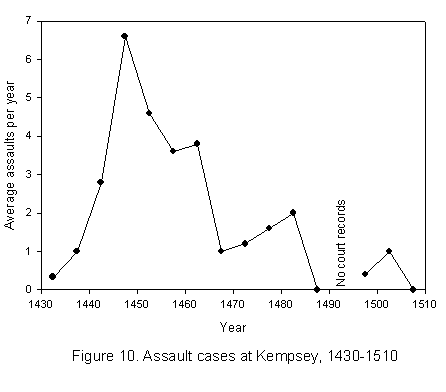
Figure 2.10 The
average number of assault cases per 5-year interval at Kempsey, Worcestershire (Dyer 1980:371).
Private
feuds, riots, and armed clashes reached such proportions that between 1448 and
1455 at least one sixth of the peerage were at some time or another imprisoned
for disreputable conduct (Lander 1976:20). The feuds of nobility gradually
became private wars, and those, in turn, merged into general civil warfare,
later called “the Wars of the Roses” (Storey 1966).
Here is a
list (probably incomplete) of counties affected by major elite quarrels c.1450,
culled from Storey (1966). (1) The West (
The year of
1450 was the year of a major popular rebellion led by Jack Cade. In fact, the
pressure in
The collapse
of royal finances in 1449 was followed by state breakdown. The parliament of
1449–50 impeached the earl of
The period
from 1471 to 1483 was a peaceful lull, but when Edward IV died, he was
succeeded by his son, Edward V, who was only 12 years old. Conflict erupted
between two elite factions, one led by the king’s maternal uncle Lord Rivers
and the other by the paternal uncle Richard of
Bosworth
marks the end of the Wars of the Roses, and indeed, the intensity of internal
warfare rapidly declined after 1485. There was a rising in Northumberland in
The
intensity of intraelite conflict during the Wars of the Roses was extremely
high. Three kings were deposed and killed, and numerous magnates were executed,
often without trial. Many ending on the losing side of a battle were simply
made to kneel in the mud and beheaded on the spot. However, its direct effect
on the population of
On the other
hand, the direct losses of combatants in the battles of the Wars of the Roses
were just the tip af an iceberg. It was not the struggle for the throne itself
that damaged the fabric of the society, but the general increase of
sociopolitical instability during the period of 1445–85. Instability manifested
itself in increased interpersonal crime, banditry, feuding, and factional
infighting. The political struggles of the great lords were themselves a
manifestation of this underlying social trend, rather than its direct cause.
We argue
that high sociopolitical instability during 1380–1485 (and within this period, particularly
1380–1410 and 1445–1485) damaged the productive capacity of the society (its
carrying capacity). The specific mechanism was the establishment of the
“landscape of fear”. The most clearcut case can be made for the peripheries,
which were largely left to fend for themselves. In the North, persistent
Scottish raids depopulated large swaths of the Borderlands. In fact, the North
was essentially abandoned by the crown to the Nevilles and Percies (who fought
each other incessantly, taking opposite sides in the York-Lancaster conflict).
Southern seashore badly suffered from the raids of the French pirates, and many
coastal areas were abandoned by the population moving inland. In the Wales the
Glyn Dŵr rebellion and the following reconquest had caused widespread
destruction (Pollard 2000:172). On a smaller scale, land was lost
in
The
situation in the central parts of the kingdom was not as dire as on the
periphery, but life of a cultivator was precarious there as well. As the list
of intraelite conflicts, given above, indicates, the breakdown of law and order
in the English countryside in the middle of the fifteenth century was the rule
rather than the exception. Common people were very vulnerable to intraelite
fighting. Many factions targeted tenants of their rivals, or any others who
were caught in the middle of conflict, for intimidation, extortion, robbery,
and simple murder. For example, Bishop Lacy of Exeter recorded in his register
that, during the private war between the earl of Devon and Lord Bonville in
1451, some of his tenants at Clyst (east of Exeter) “dared not occupy the land”
(Fryde 1991:193). Followers of Thomas Percy, Lord
Egremont, even after his death at the battle of Northampton in 1460, continued
to hold the castle of Wressle in Yorkshire against all comers, using it as a
base for raiding and harrying the country nearby (Bohna 2000:94). It was impossible to cultivate
land when you or your dependents could be robbed or murdered at any moment,
your work horses stolen, and your house burned around your ears.
Some areas
were probably more secure because local elites maintained peace; others less
so. Strong places, such as walled towns, also created a zone of security around
them. A “landscape of fear” came into being, which meant that a proportion of
arable land could not be cultivated, lowering the overall carrying capacity,
the number of people that the English soil could support.
We know that
the fifteenth century was a time of high population mobility. A facile
explanation would be that fifteenth-century Englishmen and women were
particularly footlose. Generally, however, people need weighty reasons to
abandon places into which they have invested time and labor. In the fourteenth
century such reasons could include economic oppression by landed elites, and in
the fifteenth century, breakdown of law and order.
We also know
that a great number of English villages were abandoned during the fifteenth
century. Some were probably “murdered” by landlords who wanted to turn them
into sheep pasture. Others (and this applies particularly to the smaller one)
could be abandoned because they were too insecure.
Some
migrants moved from one rural area to another, while others moved to towns. We
know that the majority of towns continued to do well during this period. Since
pre-modern towns were population sinks, the only way in which they could
maintain their numbers was by a constant influx of immigrants. When the Tudor regime
pacified the countryside, it removed an important reason for rural dwellers to
move to the security of towns. As a result, during the early Tudor period most
towns lost their population, and some of them simply withered on the vine.
2.6
Conclusion
The major
predictions of the demographic-structural theory appear to be borne out by the
data…
The great
mass of data that we reviewed in this chapter suggests that the
Malthusian-Ricardian theory of Postan and Le Roy Ladurie works quite well in
explaining the demographic, economic, and social dynamics of
The
“medieval depression”—a failure of population growth to resume once the
aftershocks of the Black Death died out, however, is a significant anomaly from
the point of view of the crude Malthusian model. We have argued in this chapter
that what is needed to understand the medieval depression is the elite and
state-centered perspective of the demographic-structural theory. The key factor
preventing population growth during the period of 1380–1485 was high
socio-political instability, manifesting as recurrent breakdown of law and
order. In turn, law and order could not be established on a permanent basis
until the numbers and appetites of the elites could be brought in line with the
productive capacity of the society. In other words, population growth could not
resume until the problem of elite overproduction was somehow solved.
For a
variety of reasons, discussed below, it took an unusually long time for this to
happen. By 1485, however, economic hardship and internal warfare during the
fourteenth and fifteenth centuries pruned the size of the English ruling class
to roughly one-third of what it was in the early forteenth century. Thus, the
numbers of magnates declined from about 200 barons to some 60 lay peers, the
middle ranks (knights and esquires) shrank from 3,000 to 1,300, and lesser
gentry from perhaps 15,000 to 5,000 (Table 2.9).
Another
aspect of the same process was the decline of the extreme economic inequality
that developed in
… but the
theory does not capture all the complexities of the historical process
We need to
stress two important qualifications to our generally positive assessment of the
fit between the theory and data in the case of the Plantagenet cycle: the
importance of exogenous factors, and the operation of other endogenous
processes that are not, strictly speaking, part of the demographic structural
theory.
One
important exogenous factor was the influence of climate. The cold and wet years
after 1315 apparently served as a trigger for the beginning of population
decline. The global cooling following the medieval optimum probably depressed
crop yields, and therefore decreased the carrying capacity the medieval-early
modern agrarian system.
An even more
obviously important exogenous shock was administered by the arrival of the
Eurasia-wide plague pandemic in
The
geopolitical situation of
Turning now
to endogenous factors, we note that standard demographic-structural models
predict continuous socio-political instability and a gradual numerical decline
of the ruling class. Yet in actuality instability waxed and wanes in waves,
interspersed with relatively peaceful periods in between. This is a general
occurrence during disintegrative phases of many secular cycles, and has been
termed by one of us (Turchin 2003b, 2006) as the “fathers-and-sons cycles.”
In the case
of Plantagenet
The basic
dynamic was set during the reigns of Edward I (1272–1307) and his son Edward II
(1307–27). Edward I reversed a century-long decline in crown revenues (Figure
2.6) and conquered
The next
iteration of the same pattern were the reigns of Edward III (1327–77) and
Richard II (1377–99). Edward III unifed the elites, achieved the highest rate
of taxation in medieval English history, and conquered half of France. His
successor Richard II alienated a major segment of the nobility (and executed
some of them). His reign saw declining revenues and the refusal of parliaments
to vote more taxes, widespread popular uprisings. Like Edward II, he was
overthrown and later died (was murdered?) in prison.
The last
cycle was the combined Lancastrian and Yorkist period. During the reign of
Henry V and the infancy of Henry VI England experienced a period of national
unification, relative fiscal stability, and successful conquest in